Physical Address
304 North Cardinal St.
Dorchester Center, MA 02124
Physical Address
304 North Cardinal St.
Dorchester Center, MA 02124

What is sports trading and how do some people seem to make consistent money from betting on sport without needing to predict the result? We’ll divulge a little more about how they go about it.
Betfair Exchange trading isn’t gambling in the way most people understand it. You’re not crossing your fingers and hoping. You’re buying and selling positions in a live (or pre-match) market, locking in profit before the final whistle – or sometimes before the first – and moving on to the next trade. It’s closer to financial trading than it is to your average Saturday acca in the pub with your mates.
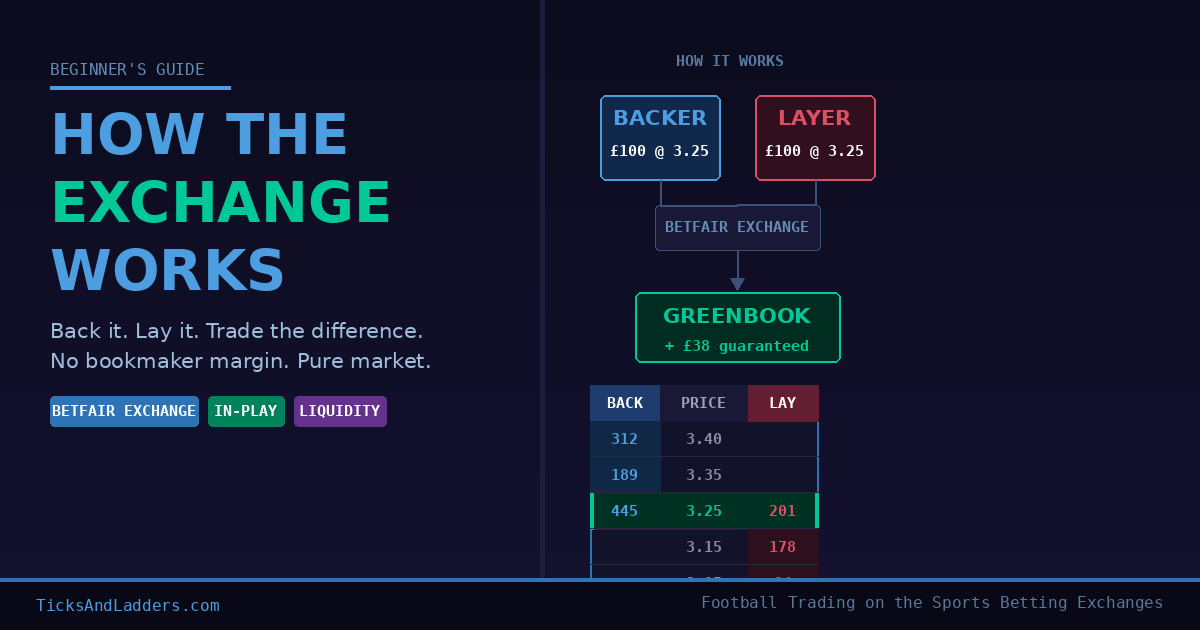
The Betfair Exchange – and the likes of Matchbook, Smarkets and Betdaq – are marketplaces where punters trade directly with each other rather than against a bookmaker. This means you can both back something to happen and lay something not to happen — and by doing both on the same selection at different prices, you can lock in a guaranteed profit regardless of the outcome.
That guaranteed profit position is called a greenbook. Getting to a greenbook is the entire objective of football trading. If you’re backing to lay, you’re hoping to back something at a high price and lay the same market at a lower price. If you’re laying to back, you want to do the opposite: lay low and back high.
Traditional bookmakers employ in-house traders to set their own odds. You either accept them or you don’t. A sports trading exchange doesn’t work like that. Odds on an exchange are set by the market — by the thousands of traders and bettors like you, all placing money simultaneously.
This creates something extraordinary: odds that move in real time in response to what’s happening in the match. It could be a goal, a red card, or a serious injury. Each of these events causes immediate price movements across every market. Those price movements are where traders make their money.
A sports exchange also allows you to lay bets. In essence, this means you can become your very own bookmaker, by accepting someone else’s bet that something will happen. If it doesn’t happen, you keep their stake. If it does, you pay out.
Let’s walk through the simplest possible example:
You didn’t need Arsenal to win. You didn’t need to predict anything. You just needed the price to move in the right direction while your trade was open.
Pre-match trading is useful, but most sports exchange traders operate in-play i.e. when the match is already underway.
In-play markets are where prices move fastest and most dramatically. A goal in the 20th minute can shift the match odds by as much as 50% once the market resettles. A red card drastically change a market’s price momentum, too. For traders who understand how football matches unfold, these movements are predictable enough to trade profitably with good risk management.
The most popular in-play markets for football traders are the match odds market, the over/under goals markets, and the correct score market. Each one behaves differently and suits different trading styles.
The golden rule at TicksAndLadders is simple: never risk more than 1-2% of your total trading bank on any single trade.
With a £500 starting bank, that’s £5-10 per trade. It sounds small. It is small. That’s the point. At 1-2% per trade, a losing run of five trades costs you 5-10% of your bank. Sure, it’s an uncomfortable amount, but a completely survivable one, too. At 10% per trade, the same losing run wipes half your capital and puts you in a psychological hole that’s very hard to trade out of.
Start small, learn the mechanics and let your bank grow at a pace your trading skills and football know-how can support.
From an individual perspective, it’s easy to understand why so many would-be football traders fall by the wayside. I’ve been a part of various sports trading communities, teeming with sharp minds and expert sporting knowledge. Each one asking the same question: “what is sports trading and why hadn’t they made good money from it before?”
The reason so many fail is their desire life-changing profits tomorrow. But the cold, hard reality is that you won’t generate those kinds of returns for at least a year or two; especially if you’re starting with a bank as small as £100-£500.
Think of this early phase as your football trading ‘apprenticeship’. Invest time in yourself and your trading skills and your bankroll will thank you in two or three years’ time. From little acorns do big trees grow.
Open a Betfair Exchange account if you haven’t already and spend one Saturday afternoon just watching markets move during live football matches. Don’t place a penny. Just watch. Watch what happens to the match odds when a goal goes in. Watch the correct score market explode. Watch the draw price drift when a team takes the lead or the under 2.5 goals price decay after a goalless opening 20 minutes.
Once you’ve seen a few of these price movements happen in real time, the whole concept of trading clicks into place in a way that reading about it never quite achieves.
When you’re ready to place your first trade, start with the smallest stake the exchange will accept. The goal isn’t profit at this stage. It’s understanding how the market responds to your positions.